

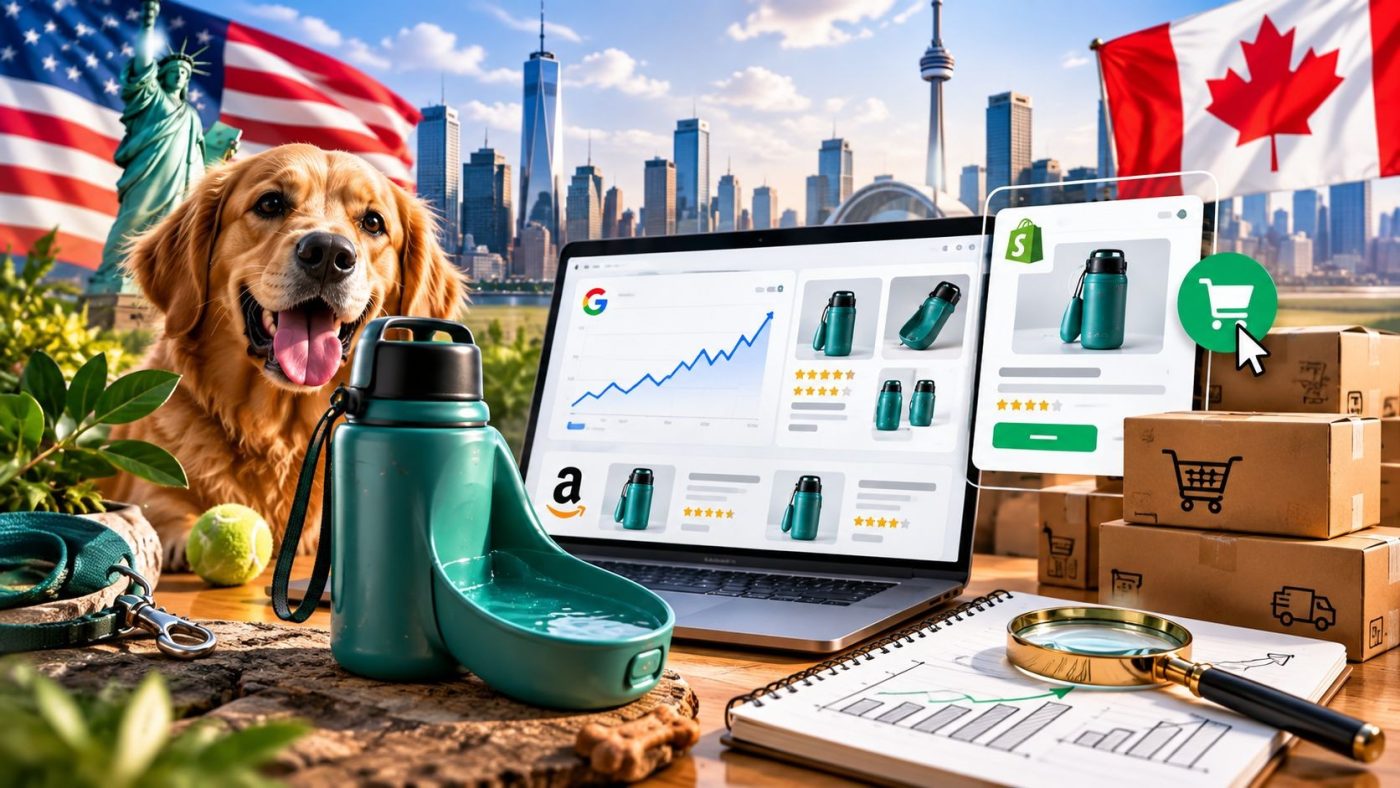
This is where your dropshipping business actually starts
If you want to build a dropshipping business for customers in the United States or Canada, don't start by creating a Shopify store.
Start with the product.
A beautiful website cannot save a product that nobody wants.
In this first guide, we are going to find a product, validate demand, study competitors, check suppliers and calculate whether the numbers make sense.
By the end of this article, you should haveone product ready to test.
Our example throughout this guide will be a fictional product called:
Portable Dog Water Bottle
The product is only an example. The same process works for other niches.
Before building the store, we first validated the product, demand, competition, suppliers and margins.
If you haven't completed that step yet, start with [Article 1: How to Find a Profitable Dropshipping Product in the USA and Canada] before continuing with the store setup.
Step 1: Choose a customer, not just a product
Instead of asking:
"What product should I sell?"
ask:
"What type of customer am I going to serve?"
For example:
Dog owners
Home-office workers
Fitness enthusiasts
Car owners
Travelers
Parents
Home organization enthusiasts
Let's choose:
Dog owners in the United States and Canada.
Now we can search for products specifically designed for that audience.
Step 2: Generate product ideas
Create a spreadsheet with at least 20 possible products.
For example:
Product | Target Customer | Problem Solved |
|---|---|---|
Portable dog water bottle | Dog owners | Giving dogs water outside |
Car dog seat cover | Dog owners | Protecting car seats |
Dog paw cleaner | Dog owners | Cleaning paws |
Automatic pet feeder | Pet owners | Feeding pets automatically |
Dog travel bag | Dog owners | Carrying pet supplies |
Don't decide yet.
We are going to validate them.
Step 3: Check demand with Google Trends
Open:
Search for your product.
For example:
portable dog water bottle
Set:
Location → United States
Time → Past 5 years
Search type → Web Search
Screenshot to add here
[SCREENSHOT 1: Google Trends showing "portable dog water bottle", United States, Past 5 years]
Then repeat the search for:
Canada
What are you looking for?
You don't necessarily need a product whose graph is exploding.
You want evidence that people are actually searching for the product or the problem it solves.
Step 4: Compare the US and Canadian markets
Create this table:
Product | US Interest | Canada Interest | Keep? |
|---|---|---|---|
Portable dog water bottle | High | Medium | Yes |
Dog paw cleaner | Medium | Medium | Yes |
Random kitchen gadget | Low | Low | No |
This prevents you from choosing a product simply because you saw it on TikTok.
Step 5: Search Google Shopping
Now search Google for:
portable dog water bottle
Look at the products appearing in Google Shopping and normal search results.
Record:
selling price;
shipping cost;
shipping time;
number of competitors;
product presentation;
reviews;
guarantees;
product variations.
If almost every competitor sells the product for $12, it will be difficult to build a profitable business selling the same thing for $14.
But if competitors sell it for $29.99 and you can source it for $8–$12, you have something worth investigating.
Step 6: Study Amazon
Search Amazon US:
Then search Amazon Canada:
Don't simply look at the number of reviews.
Read thenegative reviews.
This is one of the most useful parts of product research.
Look for complaints such as:
leaks;
poor packaging;
difficult cleaning;
weak materials;
wrong size;
slow delivery;
confusing instructions.
Those complaints can become opportunities for your own offer.
For example:
"Leak-proof design"
could become one of your main selling points if the competing products have leakage complaints.
Step 7: Find suppliers
Now we investigate whether the product can actually be sourced.
Shopify maintains a directory of dropshipping and print-on-demand apps, including suppliers serving North American merchants.
Shopify Dropshipping Suppliers
For a US/Canadian store, pay particular attention to:
Where is the inventory located?
A supplier with inventory already in the United States or Canada can potentially offer much better delivery times than a supplier shipping every order internationally.
Shopify specifically recommends checking supplier location, processing time, tracking, packaging and test orders before relying on a supplier.
Step 8: Calculate the real margin
Suppose we find:
Selling price:$34.99 USD
Product:$9.50
Shipping:$4.50
Our basic product cost is:
$14.00
Gross contribution before other expenses:
$34.99 − $14.00 = $20.99
But don't call that your profit yet.
You still have:
payment processing;
Shopify;
advertising;
refunds;
returns;
apps;
taxes;
customer service;
possible duties/import costs.
That's why a product with a $5 margin is usually much harder to advertise than one with substantially more room.
Step 9: Check the Canadian economics separately
If you sell to Canada, calculate the Canadian price separately.
For example:
US price:$34.99 USD
Canadian price:perhaps $47.99 CAD
But don't simply convert USD to CAD and stop there.
Check:
supplier cost;
currency conversion;
Canadian shipping;
taxes;
duties where applicable;
payment costs.
Shopify's current documentation explains that taxes and duties can be configured by market and that US and Canadian customers generally expect taxes to be displayed separately at checkout rather than included in the advertised product price.
Step 10: Score the product
Create your final product-selection sheet:
Question | Answer |
|---|---|
Is there demand? | Yes |
Are people already buying it? | Yes |
Can we source it? | Yes |
Can we ship it quickly? | Yes |
Is there room for advertising costs? | Yes |
Can we create video content? | Yes |
Does it solve a clear problem? | Yes |
Is it heavily regulated? | No |
If the product passes your checks, move forward.
Your task before Article 2
You should now have:
1 niche
↓
3–5 product candidates
↓
1 validated product
↓
1–3 potential suppliers
↓
a preliminary selling price
↓
an estimated margin
That's enough to move to the next stage.
Your Store Is Ready. What's Next?
At this point, you should have your product, supplier, Shopify store, domain, product page, shipping settings and US and Canadian markets configured.
But before you start accepting customers, you need to make sure the business, payment, tax and legal side is properly prepared.
Continue with [Article 3: How to Set Up the Legal, Tax and Payment Side of a Dropshipping Business in the USA and Canada].