

For the last few years, tech's favorite parlor game has been "which AI model is smarter." GPT-4 vs. Claude vs. Gemini, benchmark screenshots, leaderboard bragging rights. Fun to argue about at a dinner party. Mostly irrelevant to your actual job.
That game just got old.
The question that matters now isn't which AI is smarter. It'swhich AI can actually do the work— your work, specifically, the stuff currently sitting in your inbox.
OpenAI's launch of GPT-6 Astra is the clearest sign yet that this shift is real. The model is built to handle serious professional tasks: software engineering, data analysis, financial modeling, full computer-based workflows. OpenAI is calling it a major leap in speed and capability. Investors are calling it something else — a threat.
AI stopped waiting for instructions
Think about how you've used AI assistants until now. You ask, it answers. You type a prompt, it hands back a paragraph. Useful, but passive. It waits for you.
The new generation doesn't wait. These AI agents can:
navigate software on their own
write and modify code
analyze documents
do research
pull in outside tools
run multi-step workflows start to finish
operate a computer the way you would
That's not a small upgrade — it's a different category of thing. A chatbot helps youusesoftware. An agent might eventually justdothe job the software was built for. Once you sit with that distinction for a second, the stock market's reaction starts to make a lot more sense.
Wall Street already felt it
This isn't a hypothetical, "someday AI might disrupt software" story. It already happened, in real time.
After GPT-6 Astra launched, several major software companies took a hit. Salesforce, Intuit, and ServiceNow were among the names that dropped during a session where the broader software and services index also slid. Investors weren't panicking that these companies would vanish overnight. They were asking a sharper question:what happens to the economics of software when AI can just... do the thing the software was sold to do?
Picture a mid-sized company's software bill right now. A tool for the CRM. Another for accounting. One for project management, one for analytics, one for support tickets, one for legal research, one for marketing. A dozen subscriptions, a dozen logins, a dozen dashboards nobody fully learned how to use.
Now picture an AI agent that can move across all of those systems — or just replace a few of them outright. The value doesn't disappear. It moves. Away from the individual app, and toward whatever AI layer is sitting on top, actually running the workflow.
That's the trillion-dollar question software companies are suddenly being asked to answer.
The interface war is over — AI won
Software companies spent two decades competing on interface. Cleaner dashboards. Fewer clicks. Better menus, smarter forms, a mobile app that finally doesn't crash. All of that effort assumed a human would be the one clicking.
That assumption might not hold much longer.
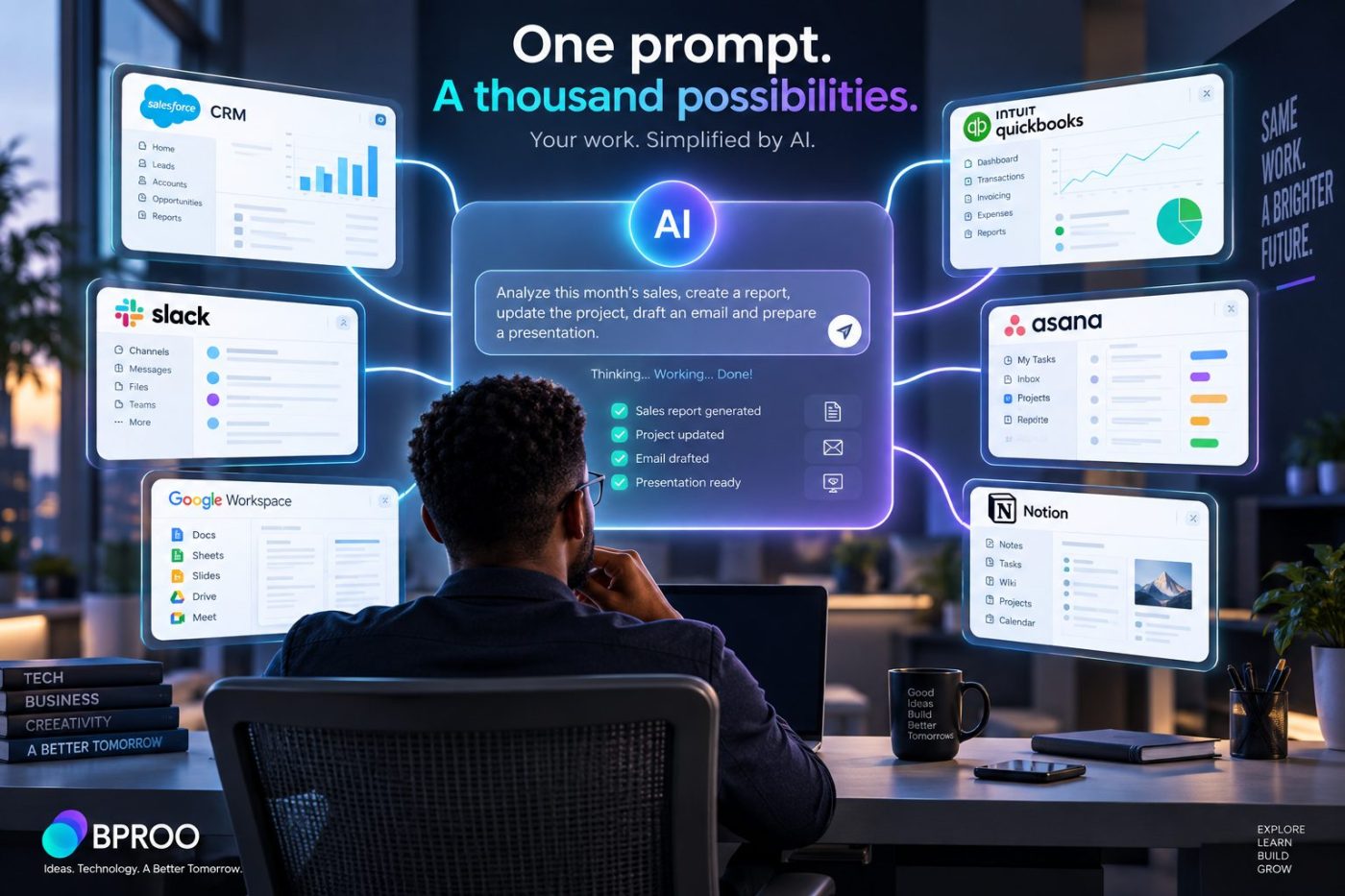
Instead of opening five separate apps to close out the month, imagine just saying:
"Analyze this month's sales, flag the biggest problems, write up a report, and send it to the management team."
And it just... happens. No dashboard-hopping, no copy-pasting between tools. That's not "add a chatbot to the sidebar." That's a fundamentally different relationship between people and software — and it's a much bigger deal than most companies are currently pricing in.
OpenAI isn't just selling a model anymore
Here's the part that should really get your attention: OpenAI isn't waiting for this future to arrive. It's building toward it, industry by industry.
The company is already expanding into professional workflows — including plans to integrate ChatGPT directly with legal software, so lawyers can update files, negotiate contracts, and search legal databases without ever leaving the ChatGPT window.
Read that again. That's not a chatbot with a legal skin on it. That's OpenAI positioning itself as theinterfaceprofessionals work through — not a tool they occasionally open, but the layer they live in all day. And OpenAI isn't the only one thinking this way. Every major AI lab is racing toward the same target.
It's also an infrastructure race — and it's global
Here's the part most coverage skips: none of this runs on nothing. The more capable these models get, the more raw computing power they burn through.
Nvidia announced this week that it plans to expand AI-related data-center capacity in Australia by up to 2 gigawatts by 2027 — more than doubling the country's current data-center capacity, according to the company and industry figures cited alongside the announcement. And Australia is just one data point in a pattern playing out worldwide.
Zoom out and the chain looks like this: chips → data centers → electricity → cloud computing → software → jobs. AI isn't just eating into software. It's reshaping the entire stack underneath it, one link at a time.
The winners might not be who you'd guess
Obviously, AI companies win here. That part's easy.
But there's a second group worth watching closely: small companies that move fast enough to actually use this stuff. A five-person team armed with capable AI agents could plausibly do work that used to require a department. That doesn't automatically mean mass layoffs — it could just as easily mean small teams start building businesses that used to need fifty people to run.
The edge is shifting. It's no longer just "who knows how to use AI." It's "who knows how toorchestrateit" — how to string agents together into something that actually delivers.
Which raises an uncomfortable question
If AI keeps eating more of the professional task list, companies are going to have to get honest about what they're actually paying humans for.
The skills that hold their value probably look like this:
judgment
creativity
leadership
communication
deep domain expertise
verification — someone has to check the AI's work
decision-making
knowing how to manage AI systems, not just use them
Put plainly: the future probably doesn't belong to whoever can out-work the AI. It belongs to whoever gets good at workingwithit.
We might be watching the next platform shift happen live
The PC changed how we compute. The internet changed how things got distributed. The smartphone changed how we access everything. Cloud computing changed the infrastructure underneath it all.
AI agents might be about to change how thework itselfgets done — not a tool bolted onto the old way of doing things, but a different way of doing things, period. GPT-6 Astra is one of the clearest signals yet that this shift isn't coming. It's already underway.
The real rivalry going forward might not even be OpenAI vs. Anthropic vs. Google anymore.
It might be AI-native companies vs. everyone still doing it the old way.
And that race has barely started.
Source: GPT-6 Astra